In conversation with Esther Bouwmans and Angèle Hahnraths
- December 5, 2023
- No category
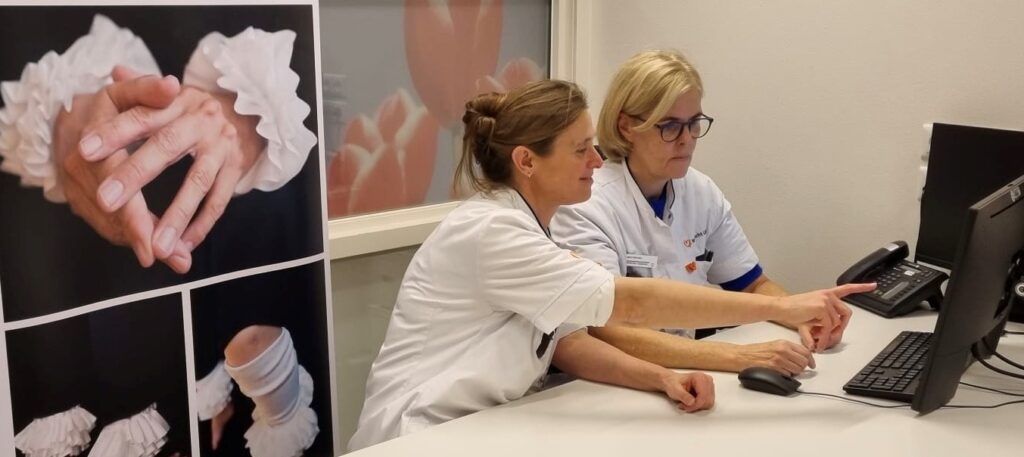
The Heart+Vascular Center at Maastricht UMC+ has been a LEEFH center since 2015. Internist-vascular physician Esther Bouwmans and nurse specialist Angèle Hahnraths work here with their colleagues to detect and treat people with FH.
Esther and Angèle have known each other since before Esther started working at MUMC+ as a medical specialist in 2011. “I completed my training here, and we clicked right away,” says Esther. “We’re both into projects, innovation, and depth. When LEEFH asked if we wanted to become a LEEFH center, we didn’t have to think twice.” FH is a key focus at MUMC+, where there’s significant potential for improvement. Angèle: “FH is a condition that can have serious cardiovascular consequences, but it is treatable. Ideally, we want to reduce the risk of (new) cardiovascular diseases through prevention. So identifying family members and raising awareness is very important!” As the regional FH consultant, Angèle is the figurehead, the driving force behind family screening for LEEFH. “When a patient tests positive for FH, the vascular team refers them to Angèle,” explains Esther. “She maps out the entire family, coordinates the family screening in consultation with LEEFH, and ensures the information about FH reaches them. She also answers questions about FH-related matters. Of course, we work together with LEEFH, which coordinates the national screening program, manages the database containing all FH patient data, and sends out information and testing kits.”
Healthcare Street
“We’re on the same page,” Esther says, describing the strength of her collaboration with Angèle. “We’re both very visually oriented and come up with all kinds of drawings and models to make information clear to patients. Just as we complement each other, that’s how we try to organize our care pathway. Together, we guide patients through the process so they receive the best care. For example, we recently created a medication selection chart that allows us to better inform and guide patients in making medication choices regarding FH treatment. Shared decision-making is a top priority for us.”
The Importance of Lifestyle and Awareness
Angèle is fully committed to developing personalized treatment plans that focus not only on medication but also on lifestyle. “Raising awareness is important so that people with a family history of FH come to us, and so that other doctors are alert to the condition and refer them,” says Esther. “Angèle and I jointly provide training to primary care physicians and other interested parties on FH, treatment, and lifestyle. Of course, we also hope that a primary care physician who sees abnormal blood test results that could indicate FH will refer people to us in an accessible way. Clinical chemistry also helps us raise awareness. Those requesting a cholesterol profile receive a notification, advice, and the request forms for LEEFH diagnostics if they have abnormalities that could be consistent with FH.”
There is still a lot of work to be done in Limburg. “In this region, there are likely still many people with FH who haven’t been identified yet. So we’re working hard to raise awareness. It’s working, because we’re seeing an increase in referrals from cardiologists and general practitioners to us. It doesn’t stop at ‘We need to see if we can lower the LDL’; a possible genetic cause is also being considered.”
Motivation is the magic word
When a person with FH is identified, treatment can sometimes be a difficult topic. “These are often healthy people who haven’t yet experienced cardiovascular disease,” Angèle explains. “They don’t feel the effects of high cholesterol and therefore don’t see the need for treatment. The stigma surrounding statin use doesn’t help either! Explanation is very important—about the condition, the possible treatment options, and the importance of a healthy lifestyle. This raises awareness, and patients are often much more motivated to adopt a healthy lifestyle and take their medication consistently. Together with the patient, I identify their challenges, we set goals, and we determine where they need help.”
Desire to have children
For people with FH, the desire to have children is also a topic of discussion. Angèle says, “Before women try to get pregnant, we discuss the consequences of temporarily stopping their medication. I also explain that a baby can be tested for FH using umbilical cord blood. Furthermore, it’s important for parents of children with FH to know that it’s recommended for children to start taking medication at age eight.”
The Future
Looking ahead, the two would like to collaborate more in what is known as the “1.5th line” of care. “This would allow us to conduct annual checkups—for example, for people with FH or those taking PCSK9 inhibitors—within the 1.5th line of care, keeping patients out of the hospital and fostering collaboration between medical specialists and primary care physicians,” says Esther. “Benefits of this could include shorter wait times for patients, making specialist care—which FH certainly is as a genetic condition—more accessible, and ensuring it is not subject to the patient’s deductible.”
Share
Share this article