“Together, we should be able to identify 70 to 80% of people with FH!”
- June 19, 2020
- Cholesterol, The people at LEEFH
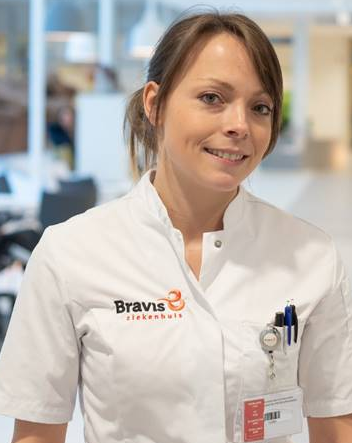
Daniella Bartels is a vascular nursing specialist in training at Bravis Hospital. She also serves as an FH consultant for LEEFH. She tells us about her work as a nursing specialist and FH consultant. “It’s a shame that the screening program has been discontinued.”
Daniella Bartels has been working at Bravis Hospital for nearly six years now, including almost two years as a vascular medicine nurse practitioner in training. She describes her work as “challenging and diverse.” She finds it challenging to help people with high cholesterol make lifestyle changes. “You can achieve a lot through lifestyle changes,” Bartels explains. “People often think they’re already living very healthily, but they’re still consuming too many carbohydrates or too much saturated fat.” For people with Familial Hypercholesterolemia (FH), it’s not always realistic to assume that a healthy lifestyle alone will eliminate the need for medication. “But often people can get by with less medication. And that’s quite an achievement,” says the nurse specialist. In practice, however, it turns out that many people struggle to adjust their lifestyle. Especially if they have a rather indulgent disposition. “I have to live,” they say. “And that does have consequences for their cholesterol levels. It’s really a challenge to lower their cholesterol in those cases. An important part of that is ensuring patients have sufficient knowledge about cholesterol and lifestyle. An app can be a good resource for that, as shown by a randomized controlled trial I recently conducted.”
Children with FH
Bartels does not see many children during her consultations, but they are there. "Children generally start taking medication at the age of eight, but if necessary, this can be earlier in cases of extremely high cholesterol levels," she explains. "From around the age of eight, the body can often get used to it. Children also often prove to be very compliant with treatment. If parents forget to give them their medication, the children themselves will remember."
"Children are very compliant with treatment."
Detecting people with FH The nurse specialist believes that the population screening program was discontinued too soon: the population screening program was a very efficient way of detecting people with FH. There are now more than 40,000 people walking around with FH who are unaware of it. I find that very sad. It is well known that these people can develop cardiovascular disease at a very young age. People with FH who are not treated often do not live past the age of 60. And that's despite the fact that in most cases the condition is very treatable. I find that very unfortunate. During my consultations, I always discuss with people who have FH that they should talk about it with their family. I then give them a package from LEEFH. You often notice that people put it aside and think: I'll deal with that later. I think it's very important not to wait too long.
Collaboration
As a nurse practitioner, it is very important for me to seek out collaboration. Not only internally within the hospital, but also with general practitioners and, in particular, practice assistants. I believe that there is still much to be gained in identifying people with FH if we seek out collaboration. For example, we have developed a diagnostic chart for practice nurses in our department, so that they can screen for certain criteria for FH. LEEFH also does a lot in the area of detection and education. Together, we should be able to detect 70 to 80% of people! I am very happy with my work. We can really make a difference for people here.
Text: Aefke ten Hagen
Photo: Daniella Bartels
Share
Share this article